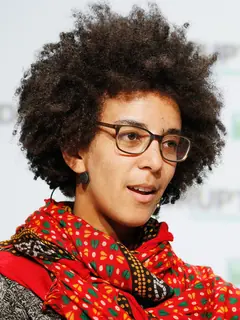
- Founder and Executive Director, Distributed AI Research Institute (DAIR)1
Timnit Gebru is the founder and executive director of the Distributed AI Research Institute (DAIR), which describes itself as an independent organization conducting community-rooted research. Before DAIR, Gebru served as co-lead of the Ethical AI research team at Google. Gebru is first author of Datasheets for Datasets, which proposes that every dataset be accompanied by a datasheet documenting its motivation, composition, collection process, and recommended uses, and a co-author of Model Cards for Model Reporting, which proposes short documents that accompany trained machine learning models and report their evaluation across a range of conditions.1234
At a glance
- Current role
- Founder and Executive Director
- Education
- Stanford
- Work listed
- 2
- Sources cited
- 6
- Profile reviewed
Career
Timnit Gebru served as co-lead of the Ethical AI research team at Google and later founded the Distributed AI Research Institute (DAIR), where Gebru is executive director. DAIR describes itself as an independent organization that grounds its research in community needs and local expertise.12
Gebru also co-founded Black in AI, a nonprofit working on inclusion and visibility in the field of AI, and serves on the board of AddisCoder, a nonprofit that teaches algorithms and programming to high school students. DAIR's site announces "Deep Unlearning", a forthcoming book by Gebru.12
Research
Gebru was first author of a 2017 study that used deep learning on Google Street View images to estimate the demographic makeup of neighborhoods across the United States. With Joy Buolamwini, Gebru co-authored "Gender Shades" (2018), which measured intersectional accuracy disparities in commercial gender classification systems.56
Gebru's work on documentation practices includes "Datasheets for Datasets" (2018), which proposes that every dataset ship with a datasheet describing its motivation, composition, collection process and recommended uses, and "Model Cards for Model Reporting" (2018), which proposes short documents reporting a trained model's evaluation across conditions and groups.34
Work and contributions
Datasheets for Datasets Published research
First author of the 2018 paper proposing datasheets for datasets, modeled on the datasheets that accompany electronic components.3
Model Cards for Model Reporting Published research
Co-author of the 2018 paper proposing model cards, short documents that accompany trained models and report benchmarked evaluation and intended use cases.4
Timeline
- First author of a study estimating demographic makeup from Google Street View images with deep learning.5
- Co-authored "Gender Shades" with Joy Buolamwini, on accuracy disparities in commercial gender classification.6
- First author of "Datasheets for Datasets".3
- Co-authored "Model Cards for Model Reporting".4
Other documented roles
Roles the sources document that are not confirmed as current.
Where they work
- Distributed AI Research Institute 1 person in the wiki
Related people
- Ajeya CotraEvaluation and benchmarks · Safety and alignment
- David StutzSafety and alignment · Evaluation and benchmarks
- Jacob SteinhardtSafety and alignment · Evaluation and benchmarks
- Peter MattsonEvaluation and benchmarks · Safety and alignment
- Yacine JerniteDatasets and data · Evaluation and benchmarks
- Jeff HuberDatasets and data · Evaluation and benchmarks
- Ian R. McKenzieSafety and alignment · Evaluation and benchmarks
- Kush R. VarshneySafety and alignment · Evaluation and benchmarks
- Hjalmar WijkEvaluation and benchmarks · Safety and alignment
- Margaret MitchellSafety and alignment · Evaluation and benchmarks
Suggest a correction or removal
Profiles cover public professional work only, and each statement cites a source. If something is out of date, missing or wrong, tell us and link a source. People can also ask for their profile to be corrected or removed.
References
6 sources · profile reviewed Oct 21, 2026 · data updated Oct 21, 2026
- Timnit Gebru — DAIR team profile
- DAIR — homepage
- Datasheets for Datasets (arXiv 1803.09010)
- Model Cards for Model Reporting (arXiv 1810.03993)
- Using Deep Learning and Google Street View to Estimate the Demographic Makeup of the US (arXiv 1702.06683)
- Gender Shades: Intersectional Accuracy Disparities in Commercial Gender Classification (PMLR 81)