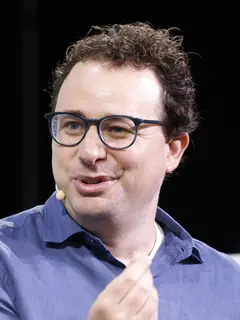
- Co-founder and Chief Executive Officer, Anthropic since 202114
- Member of the Board of Directors, Anthropic5
Dario Amodei co-founded Anthropic and leads it as chief executive officer, setting the company's research direction and strategic vision for AI systems that are reliable, interpretable, and steerable. Trained as a physicist with a PhD from Princeton University, Amodei earlier served as vice president of research at OpenAI, where Amodei led the efforts to build GPT-2 and GPT-3. At Anthropic, Amodei has championed research such as constitutional AI and interpretability alongside the Claude family of AI models.123
At a glance
- Current roles
- Co-founder and Chief Executive Officer +1 more
- Company
- Anthropic
- Honors
- 2
- Sources cited
- 15
- Profile reviewed
Accomplishments
- Co-founded Anthropic at the start of 2021 and leads it as chief executive officer.41
- As OpenAI's vice president of research, led the efforts to build GPT-2 and GPT-3.2
- Was one of the researchers who first documented the smooth, rapid improvement of AI systems with scale, while at OpenAI in 2018.3
- Guided Anthropic's research on constitutional AI, red teaming, and foundational interpretability work.36
- Led Anthropic as it introduced Claude in 2023 and Claude Code in 2025.78
- Led Anthropic as it published its Responsible Scaling Policy in September 2023.9
- Earned a PhD in physics at Princeton University as a 2007 Hertz Fellow, with a prize-winning thesis on neural circuits.2
- Wrote "Machines of Loving Grace", an optimistic vision of how AI could transform the world for the better.10
- Testified before the U.S. Senate Judiciary Subcommittee on Privacy, Technology, and the Law in July 2023.3
Education and scientific training
Dario Amodei studied at Stanford University as an undergraduate and went on to complete a PhD in physics at Princeton University, supported as a 2007 Hertz Fellow by the Fannie and John Hertz Foundation. Amodei's doctoral thesis, "Network-Scale Electrophysiology: Measuring and Understanding the Collective Behavior of Neural Circuits", earned the Hertz Foundation's thesis prize.211
After the doctorate, Amodei was a postdoctoral scholar at the Stanford University School of Medicine. Amodei has credited the Hertz Fellowship with helping, at every point in Amodei's career, to open doors and to bring exposure to new ideas.211
From neuroscience to frontier AI
Amodei then moved into artificial intelligence, working at Baidu, on the Google Brain team as a deep learning researcher, and at OpenAI.112
At OpenAI, Amodei rose to vice president of research, setting the overall research direction of the organization and leading the efforts to build GPT-2 and GPT-3. Amodei has told the Senate of being one of the researchers who first documented the smooth, rapid improvement of AI systems as they scale, while working at OpenAI in 2018.23
Co-founding Anthropic
Amodei co-founded Anthropic, which began at the start of 2021, and leads it as chief executive officer. Anthropic is a public benefit corporation whose purpose is the responsible development and maintenance of advanced AI for the long-term benefit of humanity, and Amodei serves on its board of directors.415
In 2023 Senate testimony, Amodei described the research Anthropic had conducted: constitutional AI, a method for training an AI system to behave according to a set of explicit principles; early work on red teaming, or adversarial testing of AI systems; and a series of foundational works in interpretability, the science of understanding why AI systems behave the way they do. Anthropic's constitutional AI paper, published in December 2022, explored enlisting AI systems to help supervise other AIs.36
Building Claude responsibly
Anthropic introduced Claude, a next-generation AI assistant, in March 2023, and in July 2023 launched Claude 2, which Amodei described as putting many of the company's safety innovations into practice as part of a "race to the top" on safety. In September 2023, Anthropic published its Responsible Scaling Policy, a series of technical and organizational protocols for managing the risks of increasingly capable AI systems.739
In May 2024, Anthropic reported a significant advance in understanding the inner workings of AI models, identifying how millions of concepts are represented inside Claude Sonnet. In February 2025, Anthropic introduced Claude Code, a command-line tool for agentic coding.128
Vision and recent work
Testifying before the Senate Judiciary Subcommittee on Privacy, Technology, and the Law on July 25, 2023, Amodei explained that if AI's risks can be mitigated, its benefits could be truly profound, from greatly accelerating treatments for diseases such as cancer to lowering the cost of energy and revolutionizing education.3
In the October 2024 essay "Machines of Loving Grace: How AI Could Transform the World for the Better", Amodei argued that most people are underestimating just how radical the upside of AI could be, envisioning a "country of geniuses in a datacenter" that could compress decades of progress in biology into a few years. "The Urgency of Interpretability" (April 2025) set out a goal of interpretability that can reliably detect most model problems by 2027, and "The Adolescence of Technology" (January 2026) argued that if humanity acts decisively and carefully, the risks of powerful AI can be overcome, with a hugely better world on the other side.101314
Timeline
- Amodei was named a Hertz Fellow.2
- At OpenAI, Amodei helped document the smooth, rapid improvement of AI systems with scale.3
- Amodei co-founded Anthropic, which began at the start of the year.41
- Anthropic published its research on constitutional AI.6
- Anthropic introduced Claude, a next-generation AI assistant.7
- Anthropic launched Claude 2 in the United States.3
- Amodei testified before the Senate Judiciary Subcommittee on Privacy, Technology, and the Law.3
- Anthropic published its Responsible Scaling Policy.9
- Anthropic reported mapping how millions of concepts are represented inside Claude Sonnet.12
- Amodei published the essay "Machines of Loving Grace".10
- Anthropic introduced Claude Code, a command-line tool for agentic coding.8
- Amodei published "The Urgency of Interpretability".13
- Amodei published the essay "The Adolescence of Technology".14
Other documented roles
Roles the sources document that are not confirmed as current.
- Vice President of Research, OpenAI2
- Deep learning researcher, Google (Google Brain team)211
- Postdoctoral scholar, Stanford University School of Medicine2
Honors and recognition
Where they work
- Anthropic 34 people in the wiki
Related people
- Boris ChernyAlso at Anthropic
- Jared KaplanAlso at Anthropic
- Paul SmithAlso at Anthropic
- Arthur ConmyAlso at Anthropic
- Chris OlahAlso at Anthropic
- Satya NadellaBig SI
- Elon MuskBig SI
- Andy JassyBig SI
Suggest a correction or removal
Profiles cover public professional work only, and each statement cites a source. If something is out of date, missing or wrong, tell us and link a source. People can also ask for their profile to be corrected or removed.
References
15 sources · profile reviewed Oct 11, 2026 · data updated Oct 11, 2026
- Leadership at Anthropic
- Dario Amodei - Hertz Foundation
- Written Testimony of Dario Amodei, Ph.D., Co-Founder and CEO, Anthropic, for a hearing on "Oversight of A.I.: Principles for Regulation"
- Anthropic raises Series B to build safe, reliable AI
- Company \ Anthropic
- Constitutional AI: Harmlessness from AI Feedback
- Introducing Claude
- Claude 3.7 Sonnet and Claude Code
- Anthropic's Responsible Scaling Policy
- Machines of Loving Grace: How AI Could Transform the World for the Better
- Dario Amodei: Balancing AI Innovation and Safety
- Mapping the Mind of a Large Language Model
- The Urgency of Interpretability
- The Adolescence of Technology: Confronting and Overcoming the Risks of Powerful AI
- Hertz Thesis Prize