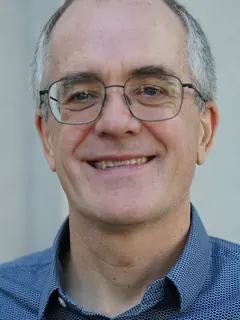
Builders & open source
Christopher Manning
Thomas M. Siebel Professor in Machine Learning, Professor of Linguistics and of Computer Science, Stanford University
- Thomas M. Siebel Professor in Machine Learning, Professor of Linguistics and of Computer Science, Stanford University1
Christopher Manning is the Thomas M. Siebel Professor in Machine Learning in the Departments of Linguistics and Computer Science at Stanford University, where Manning founded the Stanford NLP Group, and a co-founder and Senior Fellow of the Stanford Institute for Human-Centered Artificial Intelligence (HAI). Manning's homepage describes research on neural natural language understanding, including the GloVe word vectors, attention, neural machine translation, question answering, and dependency parsing, as well as work as a principal developer of Universal Dependencies. Manning co-authored textbooks on statistical NLP and information retrieval, taught CS224N, Natural Language Processing with Deep Learning, nearly every year from 2000 to 2024, and co-authored the Stanza paper for the Stanford NLP Group's Apache-2.0 Python library. Manning held faculty positions at Carnegie Mellon University and the University of Sydney before returning to Stanford.123
At a glance
- Current role
- Thomas M. Siebel Professor in Machine Learning, Professor of Linguistics and of Computer Science
- Company
- Stanford University
- Sector
- University
- Education
- Carnegie Mellon, Stanford
- Work listed
- 3
- Honors
- 9
- Sources cited
- 3
- Profile reviewed
Career
Christopher Manning earned a PhD in linguistics at Stanford in 1994, then taught in the Computational Linguistics Program at Carnegie Mellon University from 1994 to 1996 and in the Department of Linguistics at the University of Sydney from 1996 to 1999. Manning returned to Stanford in 1999 as an assistant professor of computer science and linguistics, became associate professor in 2006 and full professor in 2012, and has held the Thomas M. Siebel Professorship in Machine Learning since 2017.1
Manning founded the Stanford NLP Group, is a co-founder and Senior Fellow of the Stanford Institute for Human-Centered Artificial Intelligence, and served as President of the Association for Computational Linguistics in 2015.1
Research
Manning's earlier work built empirical, probabilistic approaches to natural language processing, including natural language inference, syntactic parsing, machine translation and multilingual processing. From 2010 the work turned to neural networks for language understanding, covering sentiment analysis, paraphrase detection, attention, neural machine translation, question answering, self-supervised pre-training and dependency parsing.1
With Jeffrey Pennington and Richard Socher, Manning introduced the GloVe word vectors at EMNLP 2014. In linguistics, Manning is a principal developer of Stanford Dependencies and Universal Dependencies, and current topics include compositionality, large pre-trained language models, knowledge and reasoning, and low-resource languages.21
Teaching and writing
Manning co-wrote the textbooks Foundations of Statistical Natural Language Processing (MIT Press, 1999) with Hinrich Schütze and Introduction to Information Retrieval (Cambridge University Press, 2008) with Prabhakar Raghavan and Schütze, along with monographs on ergativity and complex predicates. Manning taught CS 276, Information Retrieval and Web Search, from 2003 through 2019, and co-taught the 2012 Coursera NLP class with Dan Jurafsky.1
Manning has long released open-source NLP software through the Stanford NLP Group, including Stanford CoreNLP and the Apache-2.0 licensed Python library Stanza, whose ACL 2020 system paper Manning co-authored.13
Work and contributions
Stanza Open-source code
Co-author of the ACL 2020 system demonstration paper that the Stanza README gives as its citation. The Stanford NLP Python library for tokenization, sentence segmentation, named entity recognition, and parsing is released under the Apache License 2.0, and Manning's homepage names Stanford CoreNLP and Stanza as the group's open-source NLP software.31
GloVe: Global Vectors for Word Representation Published research
Co-author with Jeffrey Pennington and Richard Socher of the EMNLP 2014 paper that introduced the GloVe word vectors.2
CS224N: Natural Language Processing with Deep Learning Published research
Taught the Stanford course nearly every year from 2000 to 2024; the homepage links complete lecture video playlists and slides from five editions of the course.1
Timeline
- Completed a PhD in linguistics at Stanford and joined Carnegie Mellon University as an assistant professor.1
- Became a lecturer in the Department of Linguistics at the University of Sydney.1
- Joined Stanford's computer science and linguistics departments and published Foundations of Statistical Natural Language Processing.1
- Published Introduction to Information Retrieval with Prabhakar Raghavan and Hinrich Schütze.1
- Became a full professor at Stanford and co-taught one of the early Coursera NLP courses.1
- Co-authored the GloVe word-vector paper at EMNLP 2014.2
- Served as President of the Association for Computational Linguistics.1
- Named Thomas M. Siebel Professor in Machine Learning.1
- Co-authored the ACL 2020 system paper for the Stanza Python NLP library.3
Other documented roles
Roles the sources document that are not confirmed as current.
- Assistant Professor, Computational Linguistics Program (1994–96), Carnegie Mellon University1
Honors and recognition
- IEEE John von Neumann Medal · IEEE, 20241
- ACL Test of Time Award (three successive awards, 2023–2025) · Association for Computational Linguistics, 20251
- ACM Fellow · Association for Computing Machinery1
- AAAI Fellow · Association for the Advancement of Artificial Intelligence1
- ACL Fellow · Association for Computational Linguistics1
- Member, National Academy of Engineering · U.S. National Academy of Engineering1
- Member, American Academy of Arts and Sciences · American Academy of Arts and Sciences1
- Honorary Doctorate · University of Amsterdam, 20231
- EACL Best Paper Award · European Chapter of the Association for Computational Linguistics (EACL 2026), 20261
Where they work
- Stanford University 40 people in the wiki
Related people
- Tatsunori HashimotoAlso at Stanford University
- Percy LiangAlso at Stanford University
- Abigail SeeAlso at Stanford University
- Dan JurafskyAlso at Stanford University
- Daphne KollerAlso at Stanford University
- Antje BarthTeaching and writing · Language models
- AI ExplainedTeaching and writing · Language models
- Nathan LambertLanguage models · Teaching and writing
- Alexander AminiLanguage models · Teaching and writing
- Emily M. BenderLanguage models · Teaching and writing
Suggest a correction or removal
Profiles cover public professional work only, and each statement cites a source. If something is out of date, missing or wrong, tell us and link a source. People can also ask for their profile to be corrected or removed.
References
3 sources · profile reviewed Oct 21, 2026 · data updated Oct 21, 2026