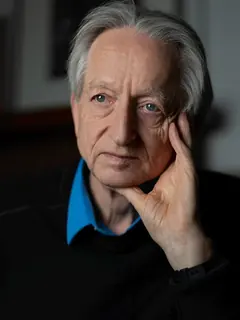
- Emeritus distinguished professor, University of Toronto15
- Chief Scientific Adviser (pro bono, since 2017), Vector Institute6
Geoffrey Hinton is an emeritus distinguished professor at the University of Toronto. From 2013 to 2023 Hinton worked half-time at Google, where Hinton became a Vice President and Engineering Fellow. Hinton designs machine learning algorithms and was one of the researchers who introduced the back-propagation algorithm. Hinton co-authored the AlexNet paper, "ImageNet Classification with Deep Convolutional Neural Networks" (NIPS 2012), and "Distilling the Knowledge in a Neural Network" (2015), and shared the 2024 Nobel Prize in Physics with John J. Hopfield "for foundational discoveries and inventions that enable machine learning with artificial neural networks".12345
At a glance
- Current roles
- Emeritus distinguished professor +1 more
- Company
- University of Toronto
- Sector
- University
- Education
- Carnegie Mellon, UCL, UC San Diego, Edinburgh, Toronto
- Work listed
- 2
- Honors
- 12
- Sources cited
- 6
- Profile reviewed
Career
Hinton received a PhD in artificial intelligence from Edinburgh in 1978 and held research posts at Sussex University, the University of California San Diego and the MRC Applied Psychology Unit. From 1982 to 1987 Hinton was on the computer science faculty at Carnegie Mellon University, then joined the University of Toronto as a professor and became a fellow of the Canadian Institute for Advanced Research.61
From 1998 to 2001 Hinton set up and directed the Gatsby Computational Neuroscience Unit at University College London before returning to the University of Toronto, where Hinton has been an emeritus professor since 2014. Hinton directed CIFAR's program on Neural Computation and Adaptive Perception from 2004 to 2013. At Google, Hinton was a half-time Distinguished Researcher from 2013 and a Vice President and Engineering Fellow from 2016 to 2023, and since 2017 Hinton has been chief scientific adviser to the Vector Institute on a pro bono basis.61
Research
Hinton's stated aim is to find learning procedures that efficiently discover complex structure in large, high-dimensional datasets, and to show that this is how the brain learns to see. Hinton was one of the researchers who introduced the back-propagation algorithm, was the first to use it to learn word embeddings, and contributed Boltzmann machines, distributed representations, time-delay neural networks, mixtures of experts, variational learning, products of experts and deep belief nets.1
Hinton's Toronto group made advances in deep learning for speech recognition and object classification, including the 2012 AlexNet paper with Alex Krizhevsky and Ilya Sutskever, which trained a large convolutional network on ImageNet. With Oriol Vinyals and Jeff Dean, Hinton wrote the 2015 paper on knowledge distillation, which compresses an ensemble of models into a single smaller model.123
Teaching
Hinton's homepage links a Coursera course on machine learning as well as 2013 undergraduate and graduate courses at the University of Toronto. Named lectures listed in Hinton's CV include the ACM Turing Lecture in 2019 and the Romanes Lecture in 2024.16
Work and contributions
ImageNet Classification with Deep Convolutional Neural Networks (AlexNet) Published research
Co-author with Alex Krizhevsky and Ilya Sutskever of the NIPS 2012 paper that trained a large, deep convolutional neural network on the ImageNet LSVRC-2010 training set.2
Distilling the Knowledge in a Neural Network Published research
First author, with Oriol Vinyals and Jeff Dean, of the 2015 paper on distilling the knowledge in an ensemble of models into a single model that is easier to deploy.3
Timeline
- Received a PhD in artificial intelligence from Edinburgh University.61
- Joined the Computer Science Department at Carnegie Mellon University as an assistant professor.6
- Became a professor of computer science at the University of Toronto.6
- Became founding director of the Gatsby Computational Neuroscience Unit at University College London.6
- Began directing CIFAR's Neural Computation and Adaptive Perception program, through 2013.1
- Co-authored the AlexNet paper on ImageNet classification with deep convolutional networks.2
- Joined Google half-time as a Distinguished Researcher.6
- Posted "Distilling the Knowledge in a Neural Network" with Oriol Vinyals and Jeff Dean.3
- Became a Vice President and Engineering Fellow at Google, a role held until 2023.6
- Became chief scientific adviser to the Vector Institute.6
- Shared the Nobel Prize in Physics with John J. Hopfield.45
Other documented roles
Roles the sources document that are not confirmed as current.
Honors and recognition
- Nobel Prize in Physics · Royal Swedish Academy of Sciences, 2024456
- Royal Medal · Royal Society, 20236
- Princess of Asturias Award · Princess of Asturias Foundation, 202261
- ACM A. M. Turing Award · Association for Computing Machinery, 201961
- Honda Prize · Honda Foundation, 20196
- BBVA Foundation Frontiers of Knowledge Award · BBVA Foundation, 20176
- IEEE/RSE James Clerk Maxwell Medal · IEEE and the Royal Society of Edinburgh, 20166
- IEEE Frank Rosenblatt Medal · IEEE, 20146
- Killam Prize in Engineering · Canada Council for the Arts, 20126
- Gerhard Herzberg Canada Gold Medal · Natural Sciences and Engineering Research Council of Canada, 201061
- David E. Rumelhart Prize · Cognitive Science Society, 20016
- Fellow of the Royal Society · Royal Society, 199861
Where they work
- University of Toronto 3 people in the wiki
Related people
- Sanja FidlerAlso at University of Toronto
- Colin RaffelAlso at University of Toronto
- Pascal VincentMachine-learning theory · Computer vision
- Mido AssranComputer vision · Machine-learning theory
- Yann LeCunComputer vision · Machine-learning theory
- Jun-Yan ZhuComputer vision
- Michael J. BlackComputer vision
- Christopher BishopMachine-learning theory
- Alex SmolaMachine-learning theory
- Justin JohnsonComputer vision
Suggest a correction or removal
Profiles cover public professional work only, and each statement cites a source. If something is out of date, missing or wrong, tell us and link a source. People can also ask for their profile to be corrected or removed.
References
6 sources · profile reviewed Oct 21, 2026 · data updated Oct 21, 2026
- Geoffrey E. Hinton — home page and brief biography
- ImageNet Classification with Deep Convolutional Neural Networks (NIPS 2012 proceedings)
- Distilling the Knowledge in a Neural Network (arXiv 1503.02531)
- The Nobel Prize in Physics 2024 — summary
- Geoffrey Hinton — Facts — 2024 (Nobel Prize in Physics)
- Curriculum Vitae — Geoffrey E. Hinton (January 2025)